
How GDT Transformed Dairy Trade

The Old Dairy Trading Model: Bilateral Deals and Tenders
Before 2008, global dairy commodities were largely traded through one-on-one negotiations or private tenders. In this traditional model, a dairy producer and a buyer would hammer out contracts in isolation, often behind closed doors. While this approach could work for individual relationships, it had clear limitations. Pricing was inconsistent and opaque, making it hard for anyone to gauge the true “market” price of products like mozzarella or butter. Each deal was a separate negotiation, consuming time and resources. For a seller, negotiating commodity sales with dozens of buyers was inefficient and costly, tying up marketing and sales teams in protracted talks. There was also no central price benchmark, companies relied on limited or outdated market indicators, which complicated planning and risk management. Some companies found that without a transparent market signal, it was challenging to make production decisions or justify returns to its farmer-owners. There was also no central price benchmark, companies relied on limited or outdated market indicators, which complicated planning and risk management it was challenging to make production decisions or justify returns to its farmer-owners. In short, the pre-GDT dairy trade lacked the visibility into broader market dynamics that modern global businesses need. Prices and terms were often hidden in private contracts, meaning the whole market had little clarity on supply-demand conditions. This lack of transparency introduced uncertainty and risk for all parties.
GDT’s Auction-Based Breakthrough
Everything began to change with the launch of Global Dairy Trade (GDT) in 2008. GDT introduced a radically different approach: a structured, ascending-price auction platform for dairy commodities. Instead of slow bilateral deal-making, sellers could now offer product volumes in a centralized online auction that all qualified buyers could attend simultaneously. GDT’s trading events use a simultaneous multiple-round ascending-price clock auction format. In simple terms, that means the auction opens at a starting price and then proceeds through a series of bidding rounds. All buyers submit how much they want to purchase at the current price. If total demand exceeds the available supply, the price is raised for the next round. Round by round, the price “clocks” upward until demand and supply come into balance, at which point the auction stops and that final price becomes the market price for that product. Crucially, every winning buyer pays the same final price, and all results are visible to the market.
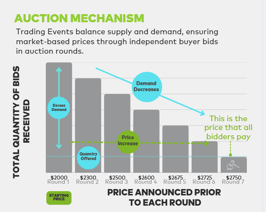
This auction structure was a major departure from private tenders: it brought speed, order, and openness to dairy trading. Deals that once took weeks of negotiation could now be settled in a single, fast-paced event. The process is highly structured – with clear rules, standardized product specifications, and set auction dates, which replaced the ad-hoc nature of previous negotiations. And it created a level playing field: all buyers see the same information and compete under the same conditions, rather than relying on personal negotiating power behind closed doors.
Efficiency, Transparency, and Clear Price Signals
The move from private negotiations to GDT’s auctions delivered significant efficiency gains and transparency for both sellers and buyers.
First, by eliminating the need for one-on-one bargaining, GDT slashed transaction costs. Sellers no longer had to negotiate separately with dozens of customers, instead one auction event efficiently matched supply with demand. Likewise, buyers saved time and effort by acquiring dairy ingredients through a single platform rather than multiple inquiries and bids. This streamlined approach reduced administrative overhead and the need for intermediaries, cutting out unnecessary middlemen.
Second, GDT greatly reduced information costs by making market data openly available. Each trading event produces credible, market-derived prices that everyone can see and reference. Price transparency went from poor to excellent , GDT’s winning prices are actual transaction prices posted for all to observe. These prices have even become internationally recognized benchmarks, showing up in industry reports and futures contracts as trusted reference points.
For the first time, dairy market participants had a clear view of global price levels, which removed much of the guesswork from trading. Instead of relying on fragmented clues or outdated indices, exporters and importers could look at GDT results and know exactly where supply and demand stood. This transparency provides clarity in market dynamics that was previously missing. Producers can plan production and investment with confidence, and buyers can budget and strategize knowing they are paying a competitive market rate. In economic terms, GDT’s auction platform improved price discovery (the process of finding the true market price). The prices emerging from the auctions accurately reflect current supply and demand conditions, giving all industry players a common signal for decision-making. That clarity helps companies manage risk and allocate resources more effectively, rather than making decisions in the dark.
Finally, the GDT model fostered a sense of fairness and predictability in the dairy trade. Because everyone faces the same price outcome, buyers can be confident they are not disadvantaged relative to their peers. Sellers, on the other hand, can be sure they’re getting a market-driven price for their product without leaving money on the table. In summary, Global Dairy Trade’s auction system replaced an inefficient patchwork of private deals with a fast, transparent marketplace. It lowered trading costs, shed light on prices, and took much of the uncertainty out of dairy transactions. For an industry that spans the globe, the ascent from bilateral negotiations to open auctions has brought much-needed speed, structure, and clarity to the market – benefiting dairy sellers and buyers alike.
Comments